A board can look very straightforward until you try to plane it. The grain runs neatly along one edge, turns around a knot, and then seems to disappear under itself. What worked at one end leaves a rough patch at the other.
I used to respond by pressing harder. This was rarely helpful.
Start by looking
Before picking up the plane, I now spend a little time with the board. I look at both edges, turn it towards the window, run a hand lightly along the face. It does not tell me everything, but it tells me more than a quick glance does.
Then a short, light pass. If the surface becomes worse, I stop. Turn the board around, take a finer shaving, check the edge. There is no virtue in repeating a cut that is clearly not working.
Often the most useful adjustment is a smaller one than I expect. Less iron showing. A little more care near the knot. Accepting that the final inch will need a different approach from the rest.
The marks that belong
Not every irregularity needs removing. A narrow dark line or a change of colour may be the best thing about the piece. I am trying to learn the difference between a surface that needs more work and one that I should leave alone.
The wood is not a blank page. It has already begun the story.
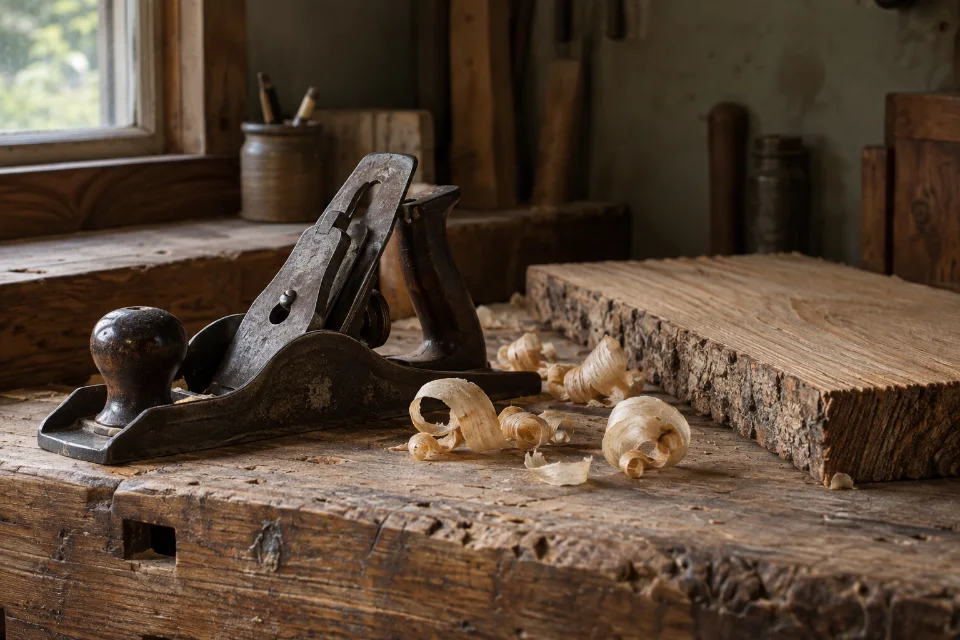
The board on the bench today is for a small shelf. Nothing ambitious. By late afternoon it was flat enough, smooth enough, and a little thinner than I had planned. The difficult patch was still visible, though no longer rough.
I put it by the window. In the sideways light, that was the part I liked most.